
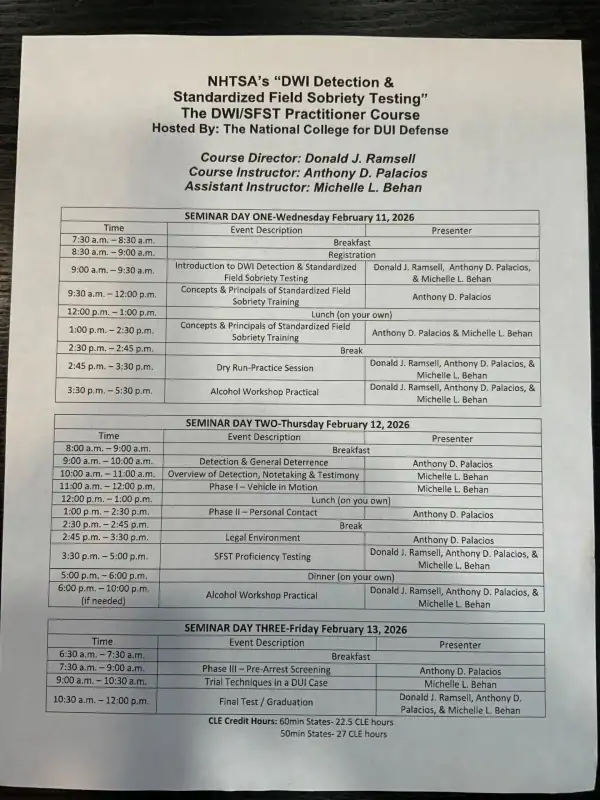
At Grano Law Offices, P.C., continuing education is a priority—especially in cases involving DWI charges. Recently, I completed the NHTSA-recognized DWI Detection & Standardized Field Sobriety Testing Practitioner Course through the National College for DUI Defense.
This is the same standardized training used by law enforcement officers across the country. Understanding how these tests are supposed to be administered—and where mistakes are often made—can make a critical difference in the defense of a DWI case.
If you are facing a DWI charge in Las Vegas, Rio Rancho, Santa Fe, Española, Taos, Raton, or anywhere in Northern or Central New Mexico, the details of these tests can be extremely important.
Table of Contents
What Are Standardized Field Sobriety Tests?
Standardized Field Sobriety Tests (SFSTs) are the roadside tests officers use to decide whether to arrest a driver for DWI. The three standardized tests are:
- Horizontal Gaze Nystagmus (HGN)
- Walk-and-Turn
- One-Leg Stand
These tests are not supposed to be performed casually or based on an officer’s guess. They are governed by strict NHTSA standards, including:
- Exact instructions the officer must give
- Proper demonstration of each test
- Specific clues the officer is trained to look for
- Standardized scoring procedures
- Required testing conditions
If those standards are not followed, the results may be unreliable or misleading.

Why This Training Matters in a DWI Case
Many DWI cases rise or fall based on how the field sobriety tests were conducted. Small errors in the process can have a major impact on the outcome of a case.
In my experience, problems often occur when:
- Instructions are given incorrectly
- The testing surface is uneven or sloped
- Lighting conditions are poor
- The driver has a medical condition or injury
- The officer rushes the process
- The tests are scored improperly
By completing this NHTSA-recognized training, I have a deeper understanding of:
- How officers are taught to administer SFSTs
- The scientific basis behind the tests
- The limitations of field sobriety testing
- Common mistakes made during roadside evaluations
This knowledge allows me to challenge improper testing and unreliable conclusions more effectively.
How Improper Testing Can Weaken the State’s Case
In many DWI prosecutions, the State relies heavily on the officer’s interpretation of the field sobriety tests. These tests are often presented to the jury as “scientific” or “standardized” indicators of impairment.
But that only holds if the tests were conducted according to the standardized NHTSA procedures.
When those procedures are not followed, several problems arise:
1. The Results May No Longer Be Reliable
The NHTSA studies that support these tests are based on strictly controlled, standardized conditions. If an officer:
- Changes the instructions
- Fails to demonstrate properly
- Tests on an uneven surface
- Rushes the timing
- Scores clues incorrectly
Then the officer is no longer following the validated protocol. In those situations, the test results may not reflect the science the State relies on.
2. The Officer’s Conclusions Can Be Challenged
In court, officers are often trained to testify that:
- They followed their training
- The tests are standardized
- The results indicate impairment
But when cross-examination reveals that the officer:
- Skipped steps
- Gave incorrect instructions
- Ignored environmental or medical factors
- Miscounted or misinterpreted clues
It can undermine the credibility of the entire roadside investigation.
3. It Creates Reasonable Doubt
In a criminal case, the State must prove guilt beyond a reasonable doubt. If the primary evidence of impairment is based on field sobriety tests that were:
- Improperly administered
- Conducted in poor conditions
- Scored inconsistently with training
Then a jury may question whether the officer’s conclusions are reliable.
A well-prepared cross-examination can highlight:
- Deviations from NHTSA standards
- Inconsistencies in the officer’s testimony
- Alternative explanations for poor performance
- The limitations of the tests themselves
When those issues are clearly presented, it can significantly weaken the State’s case.
The Reality of Roadside DWI Testing
Field sobriety tests are often conducted under far-from-ideal conditions. Many drivers are tested:
- On the side of busy highways
- In poor weather conditions
- Late at night or early in the morning
- On uneven or gravel surfaces
- While nervous, tired, or injured
Even the NHTSA training materials recognize that:
- Age can affect performance
- Weight and physical condition matter
- Certain medical issues impact results
- Environmental factors can interfere with testing
Despite these known limitations, officers often rely heavily on these tests to justify an arrest.
How This Helps My DWI Clients
With this advanced training, I am better equipped to:
- Identify errors in how field sobriety tests were conducted
- Challenge improper instructions or scoring
- Cross-examine officers about their training and procedures
- Present scientific and procedural defenses
- Expose weaknesses in the State’s case
- Protect my clients’ rights from the roadside to the courtroom
DWI defense is a technical area of law. It involves science, procedures, and strict standards. Staying current with the same training used by law enforcement helps me provide stronger, more informed representation.
Experienced DWI Defense in Las Vegas, Rio Rancho, and Northern New Mexico
For more than two decades, I have represented clients in courts throughout Northern and Central New Mexico, including:
- Las Vegas
- Rio Rancho
- Santa Fe
- Española
- Taos
- Raton
- Santa Rosa
- Los Alamos
- Mora
- And surrounding communities
If you or a loved one is facing a DWI charge in Las Vegas, Rio Rancho, or anywhere in New Mexico, it is important to work with an attorney who understands not just the law, but the science and procedures behind the arrest.
At Grano Law Offices, P.C., our mission is simple:
Helping Good People in a Bad Situation.
If you need experienced DWI defense, contact our office to discuss your case and your options.