How Solubility Defenses Beat DWI Charges
Every state in the U.S., including New Mexico, has a marijuana DUI testing problem.
With the legalization of medical and recreational cannabis throughout much of the country, law enforcement and prosecutors face a crisis of proof. Not only are they desperate to show they are tough on impaired driving, but it is now happening at a time when their traditional tools are starting to fail them. This hard-pressed state, combined with greater concern for the public interest, may have created a new legal “witch hunt” against wrongfully accused persons in marijuana DWI arrests.
Historically, police have actively conducted “saturation patrols” and sobriety checkpoints throughout the state. Last year’s Thanksgiving “C.A.R.E.” operation saw 22 DWI arrests and four alcohol-related crashes. An alarming number of New Mexico drivers could be arrested for a Marijuana DWI—not based on evidence of impairment, but on flawed tests that prove little more than “past use.”
In This Article
Marc A. Grano, our skilled DUI attorney and former New Mexico prosecutor, has hands-on experience in how the state builds cases. His advanced training with Drug Recognition Experts (DREs) enables him to analyze and address potential and actual systemic flaws in police evidence-gathering procedures. Grano Law Offices, P.C. has written this article to provide a general overview of the case for individuals who have been arrested and wish to learn more about their legal options.
Table of Contents
The Core Scientific Fallacy: A "Lipophilic" Truth
A prosecutor’s entire case for a simple alcohol-DUI conviction rests on a specific number: 0.08. Decades of research show a direct correlation between a person’s Blood Alcohol Content (BAC) and their level of cognitive impairment. The reason for this outcome is that alcohol is water-soluble, meaning that your body processes it and eliminates it quickly, in a predictable line.
In this day and age, the criminal justice system is now trying (and failing) to apply this same logic to marijuana DUI arrests. This approach is flawed because the two compounds are processed through the body in two different ways.
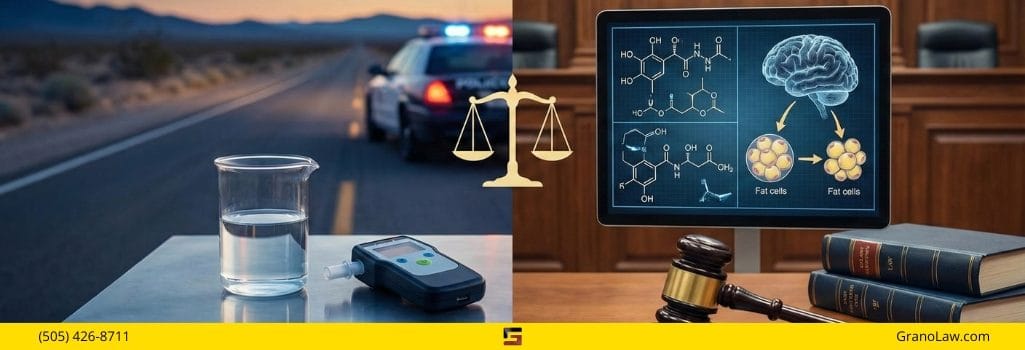
The psychoactive compound in cannabis, Delta-9-Tetrahydrocannabinol (THC), is not water-soluble. It is lipophilic, or fat-soluble, meaning that the body stores it in its fat cells. Instead of rapid elimination through normal urination, THC slowly leaches back into the bloodstream for days or weeks after psychoactive effects have worn off.
What does this information mean for your marijuana DUI defense?
It means that the state’s blood test is unable to prove that you were impaired at the time of your arrest under the law.. A positive blood test showing THC in your system does not prove you were impaired while driving. Instead, it only proves you may have legally used cannabis in the last several weeks.
This defense is “not just a theory;” it is scientific consensus:
- National Institute of Justice (NIJ): 2021 research shows that THC levels in biofluids "were not reliable indicators of marijuana intoxication."
- National Highway Traffic Safety Administration (NHTSA): In its 2017 Report to Congress, the NHTSA confirmed a "poor correlation of THC concentrations in the blood with impairment" and concluded that "setting per se levels is not meaningful.”
- American Bar Association (ABA): The ABA stated in 2024 that "impairment cannot be inferred from blood levels" since THC leaches from fat long after use.
The State's Legal Problem (No "Per Se" Limit)
The state’s scientific problem becomes a profound legal one in DUI matters. Unlike some states that have tried (and again, failed) to establish a “per se” THC limit, New Mexico has no such number (thankfully). NMSA § 66-8-102 could be interpreted to state that prosecutors cannot present your blood test as their sole piece of evidence against you and prevail.
Instead, they hold the burden to prove their allegations against you beyond a reasonable doubt, which is that you were “under the influence of drugs to such a degree that you were incapable of safely driving.”
Law enforcement may have arrested you for a marijuana DUI in New Mexico, but can they prove, with admissible, discoverable evidence, that you were, in fact:
- Under the influence of drugs, and
- Incapable of driving safely?
Since their blood test is scientifically incapable of proving either of these facts, they must rely on a different weapon of choice. It is less scientific and rests on the opinion of a police officer with specialized training known as a Drug Recognition Expert (DRE).
The 12-Step DRE Protocol
When a police officer suspects a marijuana-DWI and the breathalyzer shows a 0.00 BAC, they call for a “Drug Recognition Expert” (DRE). This police officer has taken a 72-hour course to identify impairment from drugs; the very same course our marijuana DWI lawyer holds a certification in teaching.
This DRE will execute a 12-step protocol as follows:
- Step 1. Administer a Breath Alcohol Test: This test proves that alcohol is not the suspected intoxicant.
- Step 2. Go through the Responding Officer Interview: The DRE is not a neutral scientist, which can result in classic confirmation bias during the interview.
- Step 3. Check First Pulse: The DRE will check your pulse and note the results.
- Step 4. Perform an Eye Examination: This eye exam includes the Horizontal Gaze Nystagmus (HGN), Vertical Gaze Nystagmus (VGN), and Lack of Convergence.
- Step 5. Handle Divided Attention Psychophysical Tests: These are the same flawed Standardized Field Sobriety Tests (SFSTs) used in alcohol cases.
- Step 6. Take Vital Signs and Second Pulse: The DRE will record your blood pressure, temperature, and a second pulse check.
- Step 7. Administer a Dark Room Examination: The DRE will record your pupil size, which could indicate drug use, unless you suffer from a medical condition that causes it.
- Step 8. Issue a Muscle Tone Test: Checking for “rigidity” or “flaccidity” may reveal drug use or another medical issue.
- Step 9. Look for Injection Sites and Take a Third Pulse: They will examine the injection sites and take a third pulse.
- Step 10. Make a Note of Your Statements and Observations: The DRE may arrest you at this point based on their subjective and objective observations.
- Step 11. Provide a DRE Analysis and Opinion: Based on this checklist, the officer forms an “opinion” of what drug category they believe you have taken.
- Step 12. Finalize the Toxicological Examination: The final step is the flawed blood test, which they use to “confirm” their opinion.
This 12-step process looks official. It sounds scientific. It will even intimidate you, but it is essential to remember that it is also built on arguable foundations under specific circumstances that may be more successful than you realize.
Defenses Against the DREs' Claims in New Mexico
A former prosecutor with advanced training in DUI defense, such as Marc A. Grano, knows how to cross-examine a police officer effectively. We are familiar with their training, procedures, and how to dismantle the “expert” persona they present to a jury.
The defense of a marijuana-DWI is a two-front war.
Front 1: The Legal Challenge (The Daubert Standard)
The first and most powerful attack is a pre-trial motion to exclude the DRE’s testimony entirely. In New Mexico, all “expert” testimony must pass the Daubert standard. This standard, adopted in State v. Alberico, makes the judge a “gatekeeper” who must ensure that the testimony is the product of “reliable principles and methods.”
Here is the truth: The DRE protocol is not reliable form of science. It is a checklist. Some experts even refer to it as “junk science.”
This opinion might be the finding of New Mexico’s own courts. In the landmark case State v. Aleman, the New Mexico Court of Appeals held that the DRE 12-step protocol, as a whole, is not a “scientific test”. Your experienced DWI attorney knows how to build and argue this Daubert challenge.
Front 2: The Factual Deconstruction (The Cross-Examination)
If the court allows the DRE to testify, Grano Law Offices, P.C. will then deconstruct their findings piece by piece. The state hopes the jury will see a scientific expert; your defense will potentially show them a biased officer who followed a script.
Examples of issues we might raise during your defense could include:
- Did the DRE observe “bloodshot eyes”? We will determine if they can distinguish this symptom from other causes, such as allergies, fatigue, smoke, dehydration, or irritation from contact lenses.
- Did the DRE find “Lack of Convergence”? We will note that a significant portion of the population is born with this condition, which affects eye tracking, and determine if it affects you, too.
- Did the DRE note “body tremors”? We will prove if they can distinguish “tremors” from those caused by a person who is cold, nervous, or terrified due to interaction with law enforcement.
- Did the DRE note “poor performance” on the SFSTs? We will use the officer’s own NHTSA training manual against them, where possible, and at any point during your marijuana DUI defense by challenging the SFST results.
We will expose the DRE’s opinion for what it is: a subjective, biased guess designed to justify an arrest.
A Two-Battle War: Protecting Your License vs. Fighting Marijuana DUI Charges
After a DWI arrest, you are not fighting one battle; you are actually fighting two. However, before we proceed further in this section, we would like to note that “Battle 1: The MVD Hearing” has a NON-NEGOTIABLE 10-DAY DEADLINE.
Most people believe their driver’s license and criminal case are the same thing. They are not. One is a criminal proceeding, and the other is a civil (administrative) proceeding. You can win your criminal case and still lose your license if you ignore this first battle, and vice versa.
Battle 1: The MVD Hearing
When you are arrested for DWI, the officer will confiscate your New Mexico or out-of-state driver’s license and issue you a “Notice of Revocation.” This notice now serves as your temporary driver’s license for the next 10 days. Even if you have a medical marijuana card in another state, you can still face a prescription drug DUI.
From the date on that notice, you have TEN (10) DAYS to request an MVD License Revocation Hearing formally.
If you fail to request this hearing by the 10-day deadline, your license revocation becomes automatic. You will lose your driving privileges for up to one year, regardless of the outcome of your criminal case. Even if your DWI charges are later dismissed, the Motor Vehicle Division (MVD) will not reinstate your license.
To fight for your license, you (or your attorney) must postmark or hand-deliver a formal request (Form MVD-10792 or a letter) and a $25 fee to the MVD’s Central Administration office in Santa Fe. Handling this deadline is the first and most urgent priority for your defense and for maintaining your ability to work and care for your family.
Battle 2: The Criminal Case
The second battle is the criminal case, where you face jail time, fines, and a permanent, non-expungable criminal record that will remain for more than 55 years. The stakes are high, and New Mexico law is severe, even for a first offense.
Crucially, New Mexico law mandates the use of an ignition interlock device (IID) for all DWI convictions, including first offenses. This device, which requires you to blow into it to start your car, will be needed for at least one year. This penalty applies even if your impairment was from drugs, not alcohol.
New Tech and Marijuana DUIs of the Future
The state knows its DRE program is vulnerable. That is why prosecutors and law enforcement are pinning their hopes on new technologies, such as the “THC breathalyzer”.
Companies like Cannabix Technologies are in a race to sell these devices to police department. They claim their technology can detect THC particles in a breath sample, supposedly indicating “recent use” (within a few hours).
Rest assured, these devices will face the same legal challenges in the future, including:
- They Still Don’t Prove Impairment: Detecting “recent use” is not the same as detecting impairment. A 2023 study in the Journal of Breath Research stated its “results do not support the idea that detecting THC in breath as a single measurement could reliably indicate recent cannabis use.”
- They are Untested and Unreliable: This technology is new, proprietary, and has not undergone the rigorous, independent, peer-reviewed scientific validation required by the Daubert
- The National Institute of Standards and Technology (NIST): NIST scientists have stated that testing THC in breath is “far more complicated than testing for alcohol.”
- In a July 2025 study, NIST reported its first-ever detection of THC in human breath after eating edibles, but issued a major warning: the signals “vary widely from person to person” and should not be treated as proof of recent use or impairment.
- NIST hosted a September 2025 workshop titled “Building a Path Forward for Meaningful Cannabis Breathalyzer Realization” for government training purposes that covered vulnerabilities.
Other unproven technologies, such as roadside saliva tests and cognitive-testing apps like DRUID, will face the same high legal burden. These new tools will be defeated using the same rigorous Daubert challenges that we use to defeat the DRE protocol today; the primary difference will be working with expert witnesses who understand their flaws.
Finding Gratitude in a Time of Crisis
An arrest for a marijuana-DWI is not a conviction. It is the beginning of a highly technical, science-based legal fight. The state is betting you will be too intimidated by their experts and technology to fight back.
You are letting them know that they are wrong when you hire a legal team, like Grano Law Offices, P.C.
To secure a win, the state relies on the jury (and you) not knowing the difference between a water-soluble and a fat-soluble compound. They depend on you being impressed by a 12-step protocol that New Mexico’s own appellate courts have already challenged. Plus, they are betting on you not knowing that the U.S. government’s own scientists at NIST and the NIJ have debunked the link between THC blood levels and impairment.
Marc A. Grano knows this frustrating playbook all too well.
But the month of January is a month for renewal and gratitude, even when an arrest feels like the exact opposite. Understand that the path forward is not about being grateful for a crisis; instead, it is about finding gratitude for the guaranteed existence of the legal process and seizing the opportunity for a “second chance.”
We can choose to be grateful for the following things post-arrest:
- Our criminal justice system, for all its flaws, gives you the right to a defense;
- The burden of proof, carried by prosecutors, puts the challenge on them, and;
- Your decision to walk the righteous path for a brighter future.
If you or a loved one is facing a marijuana-DWI charge in Santa Fe, Rio Arriba, Taos, or anywhere in northern or central New Mexico, do not wait. Your 10-day MVD deadline is already counting down.
The state has already built its case against you; Now, it is time to start building your defense for every stage of your case.