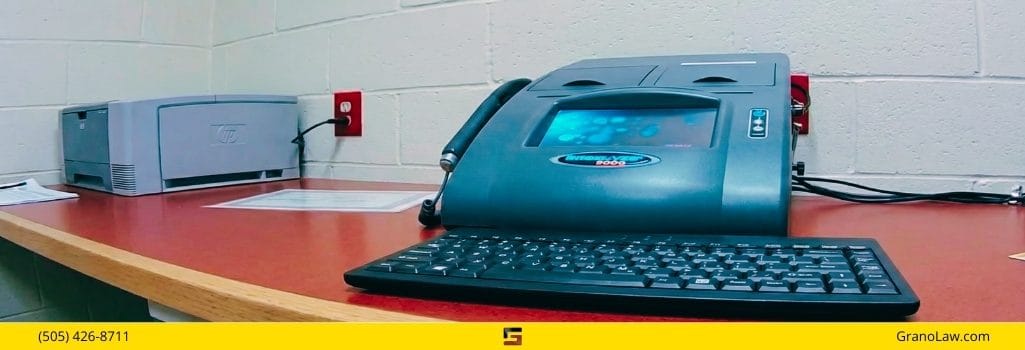
If you were recently arrested for DWI in New Mexico, you may have been tested on the Intoxilyzer® 9000. It’s new to this state, but not new technology. The 9000 is part of a long line of breath analyzers that estimate alcohol in your breath to predict alcohol in your blood.
Understanding how it works—and how it can go wrong—can be critical to your defense.
In This Article
Marc A. Grano discusses what the Intoxilyzer® is, how it works, and why results can be wrong. He wrote this post to help people understand more about New Mexico's criminal justice system and find legal information if they or a loved one are facing charges.
Table of Contents
What the Intoxilyzer® 9000 Does
Breath analyzers like the Intoxilyzer® 9000 typically use infrared (IR) spectroscopy to “look” for ethanol’s light-absorption fingerprint in a breath sample and convert that signal into a number the machine reports as a breath alcohol concentration (BrAC). Most evidentiary breath-testing machines in the United States rely on infrared spectroscopy to determine alcohol concentration in breath.

In these instruments, a subject’s breath passes through a sample chamber, and detectors measure infrared light; a microprocessor then calculates ethanol concentration based on known IR absorption properties.
Some devices and hybrids also incorporate fuel-cell sensors that generate a small electrical current when they oxidize alcohol; this signal can be used to quantify alcohol. Fuel cells oxidize ethanol at a catalytic surface and produce an electrical current proportional to the amount of alcohol in the sample.
The Science Breathalyzers Rely On
For decades, breath testing assumed that the last part of a long exhale originated deep in the lungs and directly reflected blood alcohol. Traditional breath testing was based on the belief that end‑exhaled “alveolar” air mirrors the alcohol level in blood. Modern lung science has shown that alcohol behavior in the airways is more complicated.
Researchers now recognize that alcohol can be absorbed and released by the mucus lining of the trachea and airways, which helps explain discrepancies between breath and blood results. Variations in lung size and breathing patterns can systematically affect breath readings, with larger lung volumes tending to yield higher BrACs.
Why New Mexico’s “New” Machine Isn’t New Tech
The Intoxilyzer® 9000 is a newer model for New Mexico agencies. Still, it relies on the same underlying methods used nationwide for years: infrared spectroscopy (and, in some platforms, fuel-cell confirmation).
IR spectroscopy, as applied to breath testing, has been in evidentiary use across the United States for a long time, using standardized components such as a sample chamber, lamp, filters, and detectors. Fuel‑cell sensors have also been widely used in portable and some evidential devices, valued for their relative specificity for alcohol.
Common Issues Seen in Other States—And Relevant Here
Here are a few other common issues seen in other states that are also relevant here in New Mexico:
- Interfering substances and “non‑specificity.” Compounds such as acetone or toluene can absorb IR light at ethanol‑like wavelengths. They may be misread as alcohol, especially in single‑wavelength instruments or in people exposed to solvents or with medical conditions. Historical experience with earlier Intoxilyzer models highlighted non‑specific IR detection that could respond to methyl‑containing compounds in breath, potentially elevating results.
- Mouth alcohol. Alcohol from recent drinking, belching, reflux, or certain medications can contaminate the mouth and inflate readings; accuracy depends on strict adherence to a 20‑minute observation period. If mouth alcohol is present, IR instruments can overstate results because they assume deep‑lung air and apply a conversion based on a fixed partition ratio.
- Temperature effects. Breath testing assumes an exhaled breath temperature of about 34°C, but for each 1°C increase, the BrAC reading can rise by up to 7%.
- Breath‑to‑blood conversion assumptions. Machines typically assume a 2100:1 breath‑to‑blood partition ratio, yet actual human ratios vary widely and can be influenced by physiology and breathing patterns, causing some people’s BrAC to overstate their actual BAC.
- Breathing pattern and effort. Hyperventilation, breath‑holding, shallow vs. forced exhalation, posture, and cooperation can all shift the reported BrAC.
- Calibration and simulator controls. Accuracy depends on routine checks using simulator solutions or dry gas at controlled temperatures; solution degradation, contamination, or temperature drift can compromise validity.
- Software transparency. Evidential breath analyzers rely on proprietary firmware not open to public review, raising concerns about undetected coding assumptions, rounding, or auto‑averaging that clients cannot easily scrutinize.
A Closer Look at How Results Can Be Skewed
Specificity and environmental exposure: Industrial solvents and household products (e.g., paints, thinners, petroleum products such as toluene) can linger and be misread as alcohol by IR‑based devices, depending on device design and safeguards.
- Observation period compliance: If the required pre‑test observation is not performed and documented, mouth alcohol or reflux can contaminate the sample, inflating results.
- Measurement uncertainty: Breath instruments have inherent margins of error, and even commonly used models have documented uncertainty bands that matter when results are near the legal limit.
What This Info Means If You’re Facing a DWI in New Mexico
Remember, a breath test number is not the whole story.
- A thorough defense examines the person, the procedure, and the machine: Your physiology: lung capacity, body temperature, medical conditions, and medications. Lung size and breathing pattern affect BrAC; body temperature and variability in partition ratio can cause reported results to exceed the actual blood alcohol level in some individuals.
- Test administration: Observation period, instructions, breathing coaching, and adherence to the manufacturer’s protocol. Deviations in observation timing, coaching, and step‑by‑step compliance can materially affect outcomes.
- Instrument records: Calibration logs, simulator temperatures, firmware version, error codes, and location conditions. Reviewing operator and maintenance logs, calibration and simulator temperature records, software/firmware versions, and any error or ambient‑air checks is essential for evaluating reliability.
Also, it’s important to note that your DWI charges will also result in a revocation of your license unless you attend the MVD License Revocation Hearing. From the time you’re arrested, the officer will provide you with a 10-day notification, where you will have a chance to argue for getting your license reinstated after a New Mexico DUI.
Bottom Line
The Intoxilyzerâ 9000 may be new to New Mexico, but it uses the same core technologies—and has the same potential pitfalls—seen around the country. Breath results can be influenced by how you breathe, your body, the environment, and how carefully the test was run and the machine maintained.
If you’ve been charged with DWI, consult an attorney who understands science, demands records, and knows how to challenge questionable results. Effective DWI defense involves understanding the assumptions behind breath testing, identifying procedural flaws, gathering technical documentation, and using analysis where appropriate.