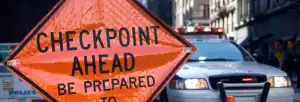
Seeing a scatter of red and blue lights flash across your windshield on a dark New Mexico roadway can induce immediate dread. Within seconds, you find yourself guided through flares and traffic cones, face-to-face with uniformed officers scrutinizing your every blink, breath, and movement. It is an overwhelming experience that can leave many drivers feeling powerless, especially if an arrest ensues.
A DWI checkpoint is a seizure under constitutional search and seizure law, even if police have no individualized suspicion that a particular driver has committed a crime. In New Mexico, that means that the checkpoint must withstand scrutiny not only under the Fourth Amendment of the Federal Constitution, but also under Article II, Section 10 of the New Mexico State Constitution. New Mexico courts have recognized that our state constitution can provide motorists greater protection against unreasonable searches and seizures than the federal constitution.
Keep in mind that an arrest is never a conviction, and you do not have to accept the officer’s narrative at face value. If law enforcement bypassed mandatory protocols, the entire foundation of the state’s case may be vulnerable. Before jumping to conclusions or accepting a quick plea deal, it is critical to understand the eight legal standards that decide whether your checkpoint arrest was lawful—or whether it can be challenged in court.
In This Article
DUI defense lawyer Marc A. Grano explains the case law ruling that established eight guidelines for conducting lawful DWI checkpoints, what each guideline is, how it works in general, and what an unlawful stop could do for your defensive strategy. Grano Law Offices, P.C. wrote this post to help people arrested at a checkpoint in northern or central New Mexico understand how the process generally works.
Table of Contents
8 Betancourt Guidelines That Determine If the Checkpoint Was Legal
Seeing flashing police lights up ahead can be an incredibly stressful experience, but a DWI checkpoint is not a blank check for law enforcement. Most people have heard of the Fourth Amendment’s protection against unreasonable searches and seizures. But people arrested for DWI in New Mexico have another important source of protection: Article II, Section 10 of the New Mexico Constitution.
New Mexico courts have recognized that Article II, Section 10 can provide greater protection against unreasonable searches and seizures than the Fourth Amendment, particularly when automobiles are involved. That does not mean every DWI checkpoint is unconstitutional under New Mexico law. It means federal law is not necessarily the end of the constitutional analysis.
New Mexico courts evaluate sobriety checkpoints under the eight factors first identified in City of Las Cruces v. Betancourt (1987). A checkpoint conducted in substantial compliance with those factors may be constitutional even though officers stopped motorists without individualized reasonable suspicion. But courts must examine the particular checkpoint and how it was actually operated, not simply assume that a roadblock was lawful because police called it a DWI checkpoint.
Below, we outline and explain each of the eight Betancourt guidelines so that you might be able to determine where police potentially got your checkpoint arrest wrong from a procedural standpoint:
Guideline 1. Role Of Supervisory Personnel
The decision to establish the checkpoint, including its basic procedures, should come from supervisory personnel rather than officers working the checkpoint in the field. This requirement supports the limitations and actions taken during sobriety checks. It also provides better assurance that the State is conducting them lawfully.
Guideline 2. Restrictions On Discretion Of Field Officers
Police cannot just randomly select which vehicles they pull over during a roadblock. Instead, law enforcement must follow uniform procedure, such as stopping every vehicle or every third vehicle, to ensure impartiality. The constitutional concern is unfettered discretion. Police cannot set up a checkpoint and then leave officers free to stop anyone they want on a hunch. If officers deviate from this guideline, it may become an important detail in challenging the constitutionality of an individual stop.
Guideline 3. Safety
DUI checkpoints in New Mexico must also prioritize the physical safety of both motorists and police officers alike. For example, law enforcement cannot set up checkpoints in a manner that causes traffic congestion or fails to provide warnings. If the police created a dangerous hazard rather than a safe testing environment, a DUI defense attorney, like Marc A. Grano, will investigate whether this element played a role in your unlawful arrest.
Guideline 4. Reasonable Location
The actual, physical location of a New Mexico DUI checkpoint must be reasonable in light of such considerations as safety, traffic conditions, and the purposes of the checkpoint.
Guideline 5. Time And Duration
Reasonableness is the standard for determining the constitutionality of a DWI checkpoint. For example, it is reasonable to believe that late-night, weekend roadblocks are sensible for detecting impaired drivers. Courts consider whether the time and duration of the checkpoint were reasonable, including whether its operation unnecessarily interfered with ordinary traffic.
Guideline 6. Indicia Of Official Nature Of The Roadblock
It should be blatantly obvious to a sober driver that you are approaching a sobriety checkpoint. Law enforcement should be in uniform, with clearly marked police vehicles and highly visible warning signs. Not only does this guideline underscore safety, but it also ensures that motorists understand that it is a bona fide, police-operated roadblock.
Guideline 7. Length And Nature Of Detention
Police must also minimize the length of detention and intrusiveness to avoid unreasonable traffic delays during a checkpoint operation. Officers may only detain you long enough to explain the purpose of the stop and look for obvious, visible signs of intoxication. If they believed that you warranted further investigation at the time, law enforcement should have instructed you to pull over to a separate testing area to keep traffic moving as smoothly as possible.
Guideline 8. Advance Publicity
A DWI roadblock should also serve as a deterrent by communicating to the public that one is underway. State v. Swain specifically reaffirmed that the lack of advance publicity, standing alone, is insufficient to make a DWI checkpoint an unconstitutional seizure. But advance publicity remains part of the overall Betancourt analysis.
How an Unlawful DUI Checkpoint Can Become Your Defense
An arrest is not a conviction, and just because you were detained at a holiday roadblock does not mean the state has a lock-tight case against you. Police must adhere to established protocols when operating these checkpoints. If they fail to do so, an unlawful DUI checkpoint can become a focal point of your defensive strategy.
Even if a checkpoint was lawful, this does not give police unlimited authority to investigate every driver for DWI. At Grano Law Offices, P.C., we will scrutinize:
- Was the checkpoint itself constitutional?
- Did the officer have legal grounds to expand the detention?
- Was there probable cause for the arrest?
- Were the field sobriety tests administered appropriately?
- Was breath or blood evidence lawfully obtained and scientifically reliable?
- Calibration logs of the Intoxilyzer 9000
- And more
Remember that a DWI charge operates on two completely separate tracks: the criminal case and the administrative license revocation case. While a criminal conviction under NMSA § 66-8-102 carries severe penalties, including jail time and fines, the civil administrative revocation case catches many people by surprise. Ensure you speak with a DUI defense lawyer before that 10-day window to request a hearing closes.
You Do Not Have to Accept the State’s Narrative
If officers depart from the checkpoint’s established procedures, such a deviation may be important in challenging the constitutionality of an individual stop. At Grano Law Offices, P.C., we relentlessly audit police procedures because we help good people in a bad situation. If you want legal advice, schedule your Free Case Strategy Session today by calling (505) 426-8711 or message us below.